



Researchers at the MRC Laboratory of Medical Sciences (LMS), Imperial College London and their collaborators have uncovered a crucial mechanism that cells use to control when to start DNA copying. This helps scientists understand one of the most fundamental processes in biology – how cells accurately duplicate their genomes.
By Emily Armstrong
August 17, 2026
Time to read: 5 minutes
Every time a cell divides, it must accurately copy its entire genetic instruction manual. Before this process can begin, cells load their DNA-copying motor – a complex of six subunits known as the MCM2-7 helicase – onto DNA. However, this motor is deliberately kept inactive to prevent replication starting at the wrong time.
Despite decades of research, scientists have not fully understood how cells switch this machinery on.
Now, a team from the MRC Laboratory of Medical Sciences and Imperial College London led by first authors Dr Yasunori Noguchi and Dr Almutasem Saleh and senior author Professor Christian Speck, has revealed the underlying structural changes that allow DNA replication to get underway.
The study, published in Nature Communications, identifies how a specialised protein pair, Sld3 and Sld7, recognise that the MCM2-7 helicase is “switched on”, allowing them to recruit a key component, Cdc45, needed to activate it and allow replication to proceed to the next steps.
Understanding the molecular safety catch
To make this discovery, the team first had to work out how the helicase itself is prepared for activation. Previous research from other groups has shown that a flexible section of the Mcm4 subunit of MCM2-7 helicase acts like a molecular “safety catch” by physically covering key surfaces on Mcm4 to keep the helicase switched off until the correct moment. Christian’s team showed for that first time that it also covers surfaces on its neighbouring subunit Mcm6. A chemical tag added by an enzyme called DDK (via a process called phosphorylation) releases this safety catch, exposing the surfaces needed for the next steps of replication to begin.
This explains, at a structural level, how phosphorylation converts an inactive helicase into one that is ready for activation.
How cells know the machinery is ready
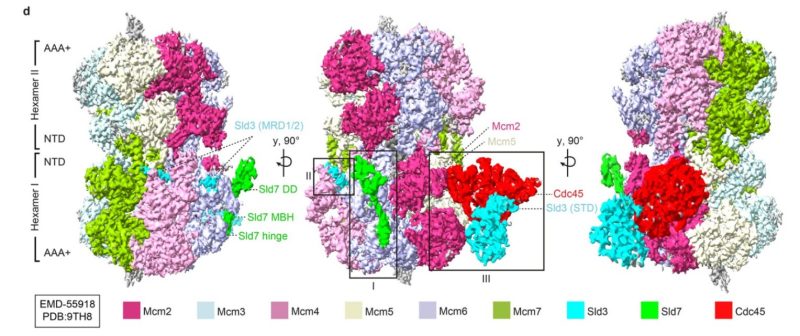
The key discovery of this research was that a protein called Sld3 acts as a molecular sensor, helped into position by its partner Sld7.
Once the safety catch has been removed, Sld3 recognises the newly exposed regions on Mcm4 and Mcm6 and binds to them. In effect, it reads whether the machinery has been switched on and only proceeds when activation has occurred correctly.
This provides an elegant explanation for how cells ensure DNA replication begins in the right place and at the right time.
Delivering a crucial component
Perhaps the most surprising discovery was how Sld3 delivers an essential component known as Cdc45, which later becomes part of the active CMG helicase – the machine that ultimately unwinds the DNA double helix.
The researchers found that Sld3 acts like a molecular adaptor. It first anchors itself to the Mcm2 part of the helicase, senses that activation has occurred and then repositions across the helicase to deliver Cdc45 to a different site, at the interface between Mcm2 and Mcm5.
When the team altered the amino acids at this newly identified Sld3–Cdc45 contact point, the machinery could still bind the helicase but could no longer recruit Cdc45 – demonstrating that this connection is essential for activation.
Capturing a previously hidden stage
The study also captured an intermediate stage between an inactive helicase and the fully active CMG motor. Rather than attaching immediately in its final position, Cdc45 first enters a partially connected state, with a further protein complex called GINS proposed to arrive afterwards to stabilise it and complete the active machine.
These structural snapshots provide an unprecedented view of the events that occur as cells prepare to copy their genomes.
Why does this matter?
Although the work was carried out using yeast proteins, the core machinery involved in DNA replication is highly conserved across species. The researchers found structural evidence suggesting that Treslin, the human counterpart of Sld3, may recruit Cdc45 by a similar principle, though this still needs to be tested experimentally.
The research does not provide an immediate treatment or medical application. Instead, its significance lies in helping scientists understand one of the most fundamental processes in biology: how cells accurately duplicate their genomes.
Genome duplication must be tightly controlled. Errors in the process can threaten genome stability and are linked to diseases in which DNA replication becomes disrupted. By revealing how cells activate the machinery that starts replication, the study provides an important foundation for future research in this area.
“Our cells must copy billions of DNA letters accurately every time they divide, so the machinery that starts this process has to be controlled with exceptional precision. We have now been able to see how a phosphorylation signal releases a molecular safety catch, how Sld3 recognises that signal and how it then delivers Cdc45 to assemble the DNA-unwinding motor. Understanding this sequence gives us a much clearer picture of the intricate regulation that protects the stability of cellular genomes,” says Christian.
This study was funded by the Biotechnology and Biological Sciences Research Council and the Wellcome Trust.
Read the full publication: https://www.nature.com/articles/s41467-026-76309-6
Note: The AI-generated (OpenAI) illustration at the top of this page represents DNA. It is intended for illustrative purposes and is not an accurate depiction of the molecular structures described in the research.