



A major new national research programme aims to accelerate discoveries in rare and inherited cardiovascular conditions – one of the leading causes of sudden cardiac death in young adults and a major cause of heart transplantation in the UK.
By Emily Armstrong
November 17, 2026
Time to read: 12 minutes
The Heart Hive Databank will create a UK-wide research resource dedicated to rare and inherited heart conditions, harnessing the UK’s unique data resources across the NHS and academia to drive scientific innovation. The programme is being launched by a team from the MRC Laboratory of Medical Sciences, Imperial College London’s National Heart and Lung Institute, University College London and the University of Oxford as part of the Rare Disease Research UK Cardiovascular Initiative.
Emerging technologies are offering hope for a new wave of genetic therapies that could correct the underlying causes of many cardiovascular diseases, and the UK is uniquely positioned to lead the way thanks to the wealth of health data being collected by the NHS and the trailblazing NHS Genomic Medicine Services. However, information relevant to specific health problems is spread across different NHS organisations and systems—making it difficult to access—and people with rare cardiovascular conditions are underrepresented in large population studies.
By bringing health and genetic data together for thousands of affected individuals into one controlled-access database, the Heart Hive Databank will enable researchers to study high-impact questions that individual centres have previously been unable to answer. Ultimately the team hopes to support research that matters to patients: understanding factors that influence disease risk, severity and progression, improving the accuracy and usefulness of genetic testing, and supporting the development of targeted treatments. The programme forms part of a wider national effort to improve research into rare diseases.
James Ware, Professor of Cardiovascular and Genomic Medicine at Imperial College London, Investigator at the MRC Laboratory of Medical Sciences, and Principal Investigator for the Heart Hive Databank, said:
“The UK has some of the world’s richest health data, with a uniquely integrated healthcare system and a pioneering Genomic Medicine Service. Despite this, information relevant to inherited heart conditions is often fragmented across different organisations, and inaccessible for research. Patients tell us they want their routine health data to be used for research, but in practice it can be hard, or impossible, for researchers to access.
“The Heart Hive Databank addresses these challenges, securely connecting these data to create a new national resource for research. Our goals are to give more people from all backgrounds the opportunity to participate in research, and to help researchers address transformative questions that have previously been impossible to study, often because individual centres simply did not have enough patients. Building on the success of the Heart Hive registry, we are delighted to now be working directly with the patient community to tackle the questions that matter most to people living with these conditions.”
Dr Kate Thomson, Principal Clinical Scientist in the Oxford Genetics Laboratories and co-lead of the Rare Disease Research Cardiovascular Initiative, said:
“Every week we perform genetic testing for families looking for answers about why a heart condition has affected them or their loved ones, and what the future risk will be to themselves, their children and relatives. Genetic testing can be incredibly powerful, but for many people the future remains uncertain. By bringing together health and genetic information from across the UK on an unprecedented scale, we hope the Heart Hive Databank will help us build a better understanding of the causes of these conditions, and ultimately provide clearer answers and better treatments for patients and their families in the future.”
Participation in the Databank has been designed to be simple and accessible. Building on the success of the Heart Hive registry, volunteers can register on the Heart Hive website in just a few minutes, complete a research questionnaire and provide consent electronically. Genetic information will either be collected from existing NHS samples or through a postal sample collection kit.
All families in the UK who are affected by a rare or inherited heart condition are invited to join, and the team will be partnering with NHS England to write to everyone who is eligible. Individuals can opt-in to be notified when clinical trials of new medicines or gene therapies are starting in the UK, reducing geographical barriers to research participation and supporting national clinical trial delivery for rare cardiovascular diseases.
A key priority is ensuring that the Databank reflects the diversity of the UK population. The team will work closely with trusted community organisations to engage with people from groups that have historically been under-represented in cardiovascular research, helping to ensure future discoveries benefit all communities.
Hugh Watkins, Radcliffe Professor of Medicine at the University of Oxford and Principal Investigator of CureHeart, said:
“In CureHeart, our vision is to develop genetic therapies that address the underlying causes of inherited cardiomyopathies, rather than simply managing their consequences. Developing treatments depends on robust partnerships with families affected by these devastating conditions, and understanding, at scale, how genetic changes affect cardiovascular health. By strengthening the link between patients, researchers and clinical trials, the Heart Hive Databank will play a vital role in giving families access to research wherever they live, and helping trials reach the people who could benefit from them.”
The Rare Disease Research UK Hub Team said:
“People living with rare conditions often face long waits for a diagnosis, limited treatment options and uncertainty about their future. Rare Disease Research UK is working to address these challenges by bringing together patients, researchers and expertise across the country. The launch of the Heart Hive Databank through our Cardiovascular Initiative Node creates a powerful opportunity to accelerate discoveries, expand access to research and pave the way for more effective treatments, with the potential to transform the lives of people and families affected by rare and inherited heart conditions.”
Rare and inherited cardiovascular conditions are a group of diseases that affect the heart muscle, heart rhythm or major blood vessels, and often run in families. Collectively, they affect at least 1 in 250 people, but the individual genetic causes of disease can be very rare – every affected family may have a different genetic variant driving their condition. In the UK, 12 people under the age of 35 die each week from undiagnosed rare cardiovascular conditions.
While genetic testing has transformed care for many families, a large number of people still do not receive clear answers about the cause of their condition or the future risk to their family. These conditions can often be managed with existing medications, but currently they cannot be cured.
Liz Cooper was diagnosed with dilated cardiomyopathy at the age of 28, after her mum had two unexpected cardiac events in the space of two years. Liz later found out that both her and her son inherited a genetic variant in the LMNA gene, which is associated with a high risk of sudden cardiac arrest. She was part of a focus group that helped to guide the development of the Heart Hive Databank. Liz said:
“There have been times when I felt if I leave the house, I’m not sure I’m going to make it home. It is a risk of the condition that I have, and the gene that I carry: I could have an arrhythmia that could lead to a cardiac arrest, even with the medication that I take… It affects my mental health on a daily basis, because it’s that sort of mental load, that uncertainty every day. And it affects my family too… I got involved in research because I wanted something done. My family, my precious children, my potential grandchildren – I don’t want them to have to deal with this… The thought of a cure being found in my lifetime would be amazing for me, but I mostly think about my son. If he never has to have the kind of the uncertainty that I’ve had, if that could be taken away… Research like this is priceless for people in our situation.”
If you have a rare or inherited heart condition and would like to hear more about taking part, visit the Heart Hive website.
_____________________________________________
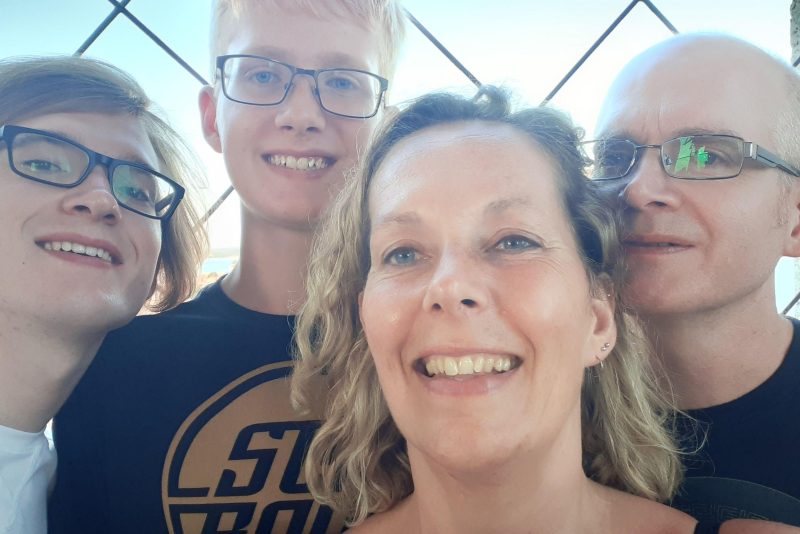
“My mum had a collapse walking home from work. There was nothing wrong with her as far as we knew. She went into hospital, had a pacemaker fitted, and then two years later had a cardiac arrest in the street. Fortunately, she got to hospital and was resuscitated, but because she’d had two events in just under two years the doctors started to investigate.
“She was really at the beginning of them thinking – this could be genetic; we could maybe check for this. Her dad died suddenly in his sleep when he was 54; he had a brother who died suddenly at the age of 48. So, it was decided that it would be best if my sister and I were both checked. Although I didn’t have any symptoms, my measurements were all just at the upper end of normal, so they decided to keep track of me.
“I had my first son in 2004, but the hospital wasn’t really prepared, and they kept moving me around… I think nobody wanted me to be on their ward in case something happened to my heart even though I was asymptomatic. Then I had a 24-hour tape, and that showed my heart rate got up to 220 beats a minute while I was asleep. So, they decided to fit an ICD, which I had when he was 8 months old.
“I had a genetic test in 2006, which was when we found out that I have a faulty copy of the Lamin A/C gene. There have been times when I felt if I leave the house, I’m not sure I’m going to make it home. It is a risk of the condition that I have, and the gene that I carry: I could have an arrhythmia that could lead to a cardiac arrest, even with the medication that I take. I’ve had two cardiac arrests, and both were me going somewhere and collapsing in the street, so there’s always that concern that it could happen again. It affects my mental health on a daily basis, because it’s that sort of mental load, that uncertainty every day. And it affects my family too.
“My oldest son, at the age of 5, made me an ICD so that I would never have to worry that my battery might run out. That much care and concern and thought from a five-year-old is really, really moving, but it’s also quite sad that they’ve had to have that in their lives.
“They both grew up knowing that they might have inherited the gene change that I have, and they had genetic testing when they were 11 and 13. My younger son does carry the gene and my older son doesn’t. That’s had an impact on so many things, because my husband and I made that decision to have children. To an extent, yes, we did know that it could be passed on, but when I was pregnant the whole point of any conversation about risk was about the burden it would place on my heart. I think we probably didn’t fully understand the risk to them.
“I got involved in research because I wanted something done. My family, my precious children, my potential grandchildren – I don’t want them to have to deal with this.
“I’ve traced back sudden deaths in our family at the age of 50-ish, and I’ve got back to 1840. It’s really interesting to see how strong that genetic inheritance is – going back and back and back, all these people dying from this same problem.
“The thought of a cure being found in my lifetime would be amazing for me, but I mostly think about my son. If he never has to have the kind of the uncertainty that I’ve had, if that could be taken away… Research like this is priceless for people in our situation.
“I think that’s a good thing with things like the Heart Hive, where you can almost take a positive out of your diagnosis – this could help me and who knows who else. And one of those people might even be someone I’m distantly related to if this is a genetic cause. So, I find that really reassuring and quite inspiring as a reason for wanting to be part of it.
“I’m also supporting with fundraising for Cardiomyopathy UK because they’ve been really supportive, and really helpful when I’ve just needed someone to talk to. I think people often underestimate how much their donation can really change people’s lives, and just people’s everyday existence of knowing that there are other people out there who care.”
_____________________________________________
For more information about rare and inherited cardiovascular conditions, visit the British Heart Foundation website. For support living with cardiomyopathy, visit the Cardiomyopathy UK website. For bereavement support after the tragedy of a young sudden cardiac death, visit the Cardiac Risk in the Young website.
The Heart Hive Databank is funded by Rare Disease Research UK, a national initiative jointly funded by the Medical Research Council (MRC) and the National Institute for Health and Care Research (NIHR). It builds on previous Heart Hive funding from Cardiomyopathy UK, Sir Jules Thorn Charitable Trust, and the BHF Big Beat Challenge award (CureHeart). The programme forms part of the BHF-NIHR Cardiovascular Partnership for Rare and Genetic Cardiovascular Diseases and is led by Professor James Ware (Imperial College London and MRC LMS), Dr Tom Lumbers (UCL) and Dr Kate Thomson (University of Oxford).